Guide: storm prep
Getting a Long Island basement ready for storm season
Most flooded basements give warnings first. Here's the checklist we'd work through before the heavy-rain months.
By Wallace Blackwell, Restoration Guides Editor
Quick answer
Getting a Long Island basement ready for storm season means moving roof water away from the foundation, clearing window wells, testing the sump pump with a backup power source, and checking whether a backwater valve is needed. Islip MacArthur Airport holds the state's 24-hour rain record, 13.57 inches, set in August 2014.
Why storm prep matters here
Long Island's storms have been heavy. Islip MacArthur Airport recorded 13.57 inches of rain in 24 hours in August 2014, the New York State record (source), and in August 2024 Suffolk County declared its first flash flood emergency after a Stony Brook station measured 9.40 inches (source). Rain like that tests every weak point around a foundation.
Move roof water away from the house
A roof sheds a lot of water, and gutters concentrate it into a few downspouts. Clean the gutters, check that downspouts aren't disconnected, and extend them so water lands several feet from the foundation rather than at its base.
If the ground slopes toward the house, water pools against the wall and finds its way through. Building up soil so it slopes away is often the cheapest fix there is.
Window wells and outside stairs
Window wells and outside basement stairs collect rain. Clear leaves out of their drains and pour water in to check they drain. A clogged well fills until water pours through the window; clear covers help keep leaves out.
Check the seal around basement windows and the door at the bottom of outside stairs, where water often gets in first.
Sump pumps and backup power
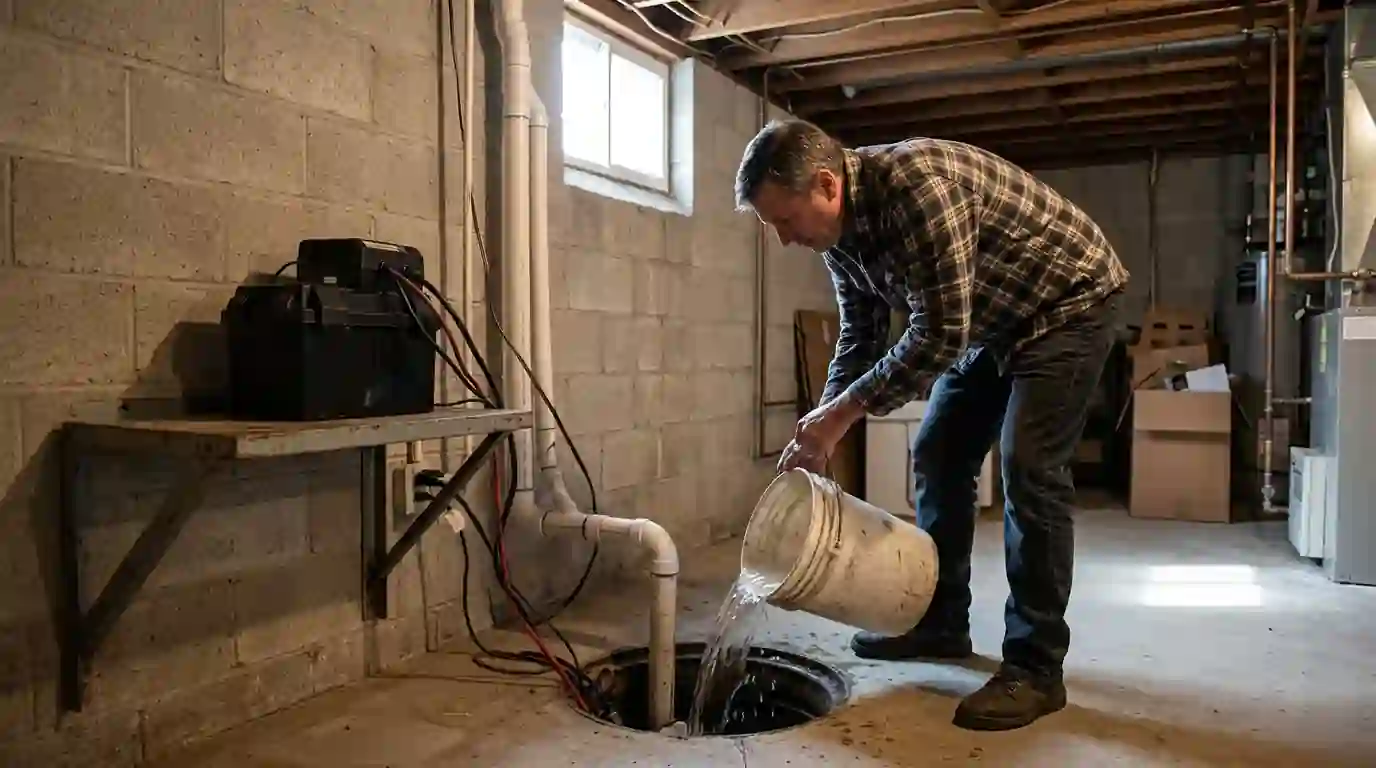
If you have a sump pump, test it before the season by pouring water into the pit until it switches on. Check that the discharge line runs outside and away from the house, not into a floor drain. Storms often cut power exactly when the pump is needed, so a battery backup or a water-powered backup pump is worth considering, along with a high-water alarm.
Backwater valves and floor drains
If the basement has backed up through a floor drain before, ask a plumber whether a backwater valve is needed; the NYC Plumbing Code requires one where fixtures sit below the level of possible sewer backflow (source), and many Long Island plumbers recommend them in low-lying houses. Our sewer backup guide explains how they work.
Get things off the floor
Store boxes on shelves or in plastic bins rather than cardboard on the slab. Raise the washer, dryer and freezer on blocks if water has reached them before. Keep important papers and anything irreplaceable upstairs.
In finished basements, know where the main electrical panel and water shutoff are, and keep a path to them clear.
Finished basements and flood-tolerant materials
If your finished basement has flooded before, rebuilding with materials that tolerate water saves the next cleanup: moisture-resistant board held a little above the slab, flooring that can get wet, and outlets set higher on the wall. Our reconstruction page explains how we rebuild lower levels.
A quick check before a named storm
The day before a big storm: clear the gutters you can reach safely, check downspout extensions are in place, test the sump pump, charge the backup battery, clear window-well drains, and move anything valuable off the basement floor. Put a flashlight and your insurer's number by the basement stairs.
Our insurance guide explains which policy usually applies if water gets in anyway.
Crawl spaces and additions
Many Long Island houses have an addition or a section over a crawl space rather than a full basement. Check that its vents and access door are sound and that no downspout empties near it. Our crawl space page covers what happens when water gets under the house.
Keep a basement inventory
Take a few photos of the basement and what's stored there at the start of the season. If water gets in, those pictures show what was lost and what condition it was in, which is much easier than rebuilding a list from memory after the cleanup.
When water gets in anyway
Stay out if water is near outlets or the panel. Photograph everything, then call. Floodwater from outside is handled as contaminated, and drywall, carpet and insulation it soaks usually come out; our basement flood cleanup page explains the job, and our insurance guide explains which policy usually applies.
Storm prep questions
What Long Island homeowners ask before the season.
Before storm season and after any long power outage.
If your basement has flooded when the power went out, it's worth it.
Several feet from the foundation, onto ground that slopes away.
No. It helps with dampness, not with water coming in during storms.
Sealing helps with dampness; for water coming through, fix grading and gutters first.
If you've had sewer backups, a plumber can tell you whether one fits your line.
Stay clear of electrical hazards, photograph everything and call.
Basement took on water?
Call and we'll pump it out and find the entry point. We answer 24/7.