Burst and frozen pipes, answered 24/7
Burst pipe cleanup and drying in New York, NY
Pipe burst and water still spreading? Close the nearest valve or the main, then call. We extract, open only what the readings say and dry the wall cavities.
- Answering 24/7
- Moisture readings every day
- Plaster and drywall
Quick answer
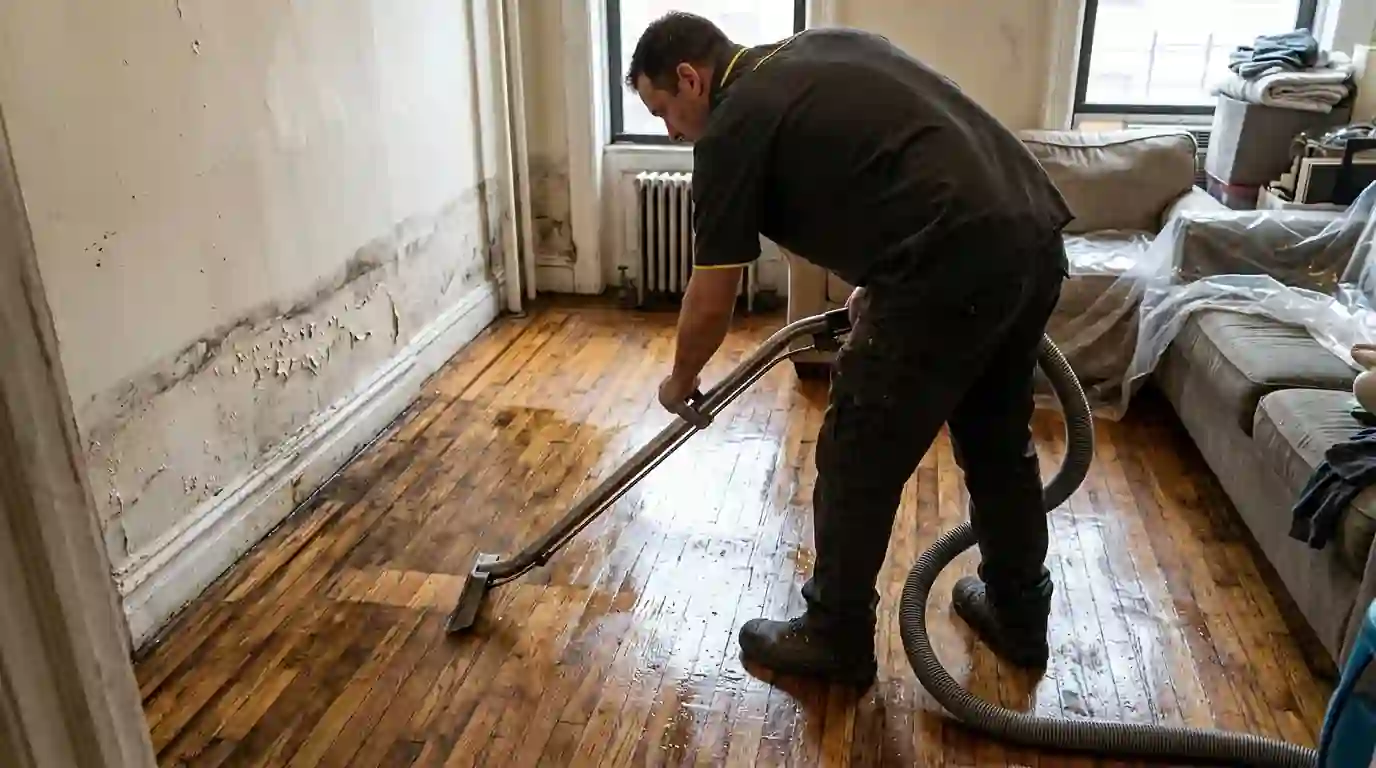
Water from a burst pipe in a New York, NY apartment can start feeding mold within 24 to 48 hours, so close the nearest valve or the building main first. We extract the standing water, map where it traveled with meters and thermal imaging, and dry the wall cavities before anything is closed up.
What a burst pipe does inside a New York wall
Most burst pipes are supply lines under pressure, so they keep running until someone closes a valve. The water follows the pipe, then gravity. It soaks the plaster or insulation around the break, runs down the stud bay and spreads under the floor at the base of the wall.
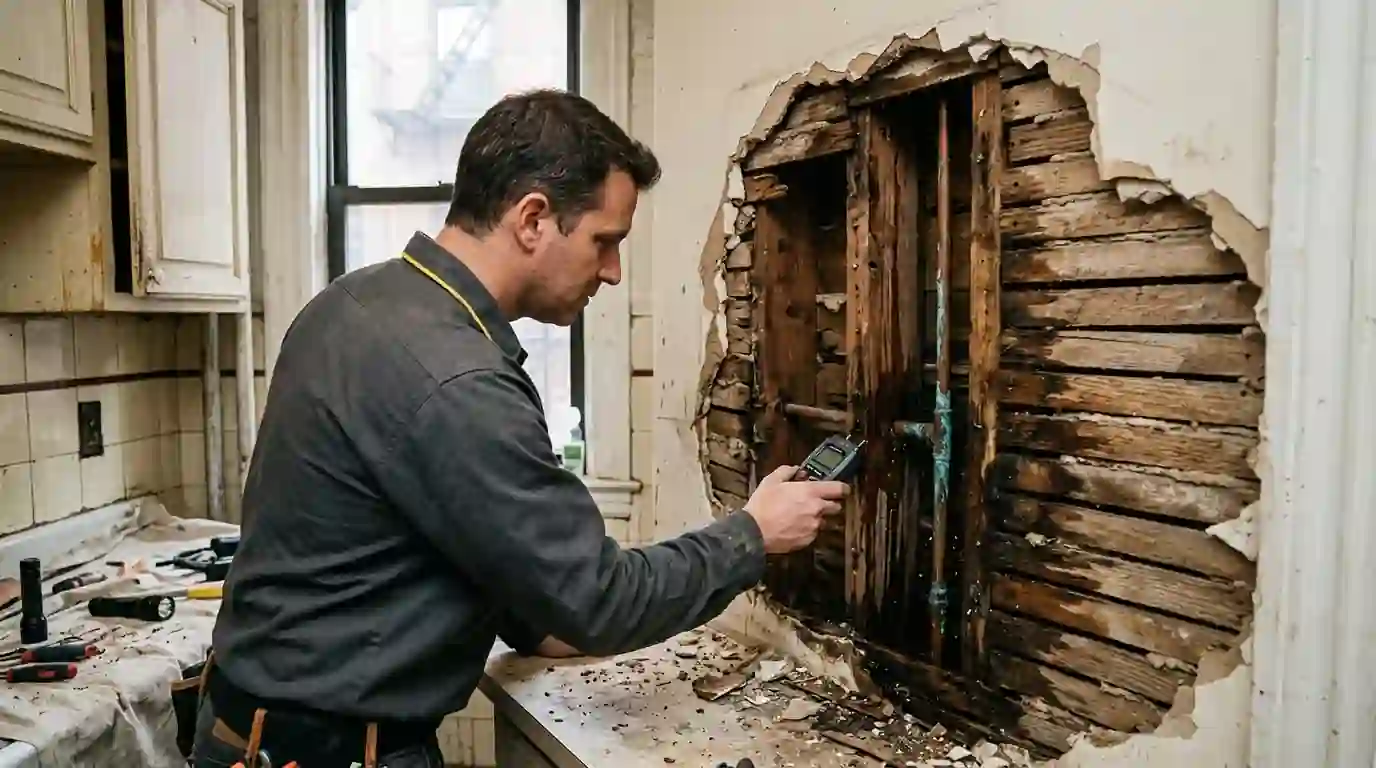
That is why the stain you see is rarely the whole story. A leak in a kitchen wall can show up as a swollen baseboard two rooms away, or as a stain in the apartment below. We measure before we cut, so the opening is only as big as the wet area.
Older buildings add a wrinkle. Galvanized and brass lines corrode from the inside, and a repair at one joint often stresses the next. Your plumber fixes the pipe; we deal with the water it left behind and the wall it came out of.
Signs a pipe has burst or is leaking inside a wall
Not every break sprays. Slow splits show up like this.
Pressure drops at one fixture
A tap that suddenly runs weak while the others are fine can mean a split line feeding it.
Paint bubbling low on a wall
Water running down the stud bay pools at the bottom plate and lifts the paint just above the baseboard.
A meter that moves with taps off
If the water meter keeps turning with every fixture closed, water is escaping somewhere in the lines.
A new stain under a kitchen or bath
Most supply lines run in those walls, so a stain below them is the first place to look.
Pipes on exterior walls in a cold snap
Lines in unheated corners, crawl spaces and outside walls freeze first and split when they thaw.
Frozen pipe bursts
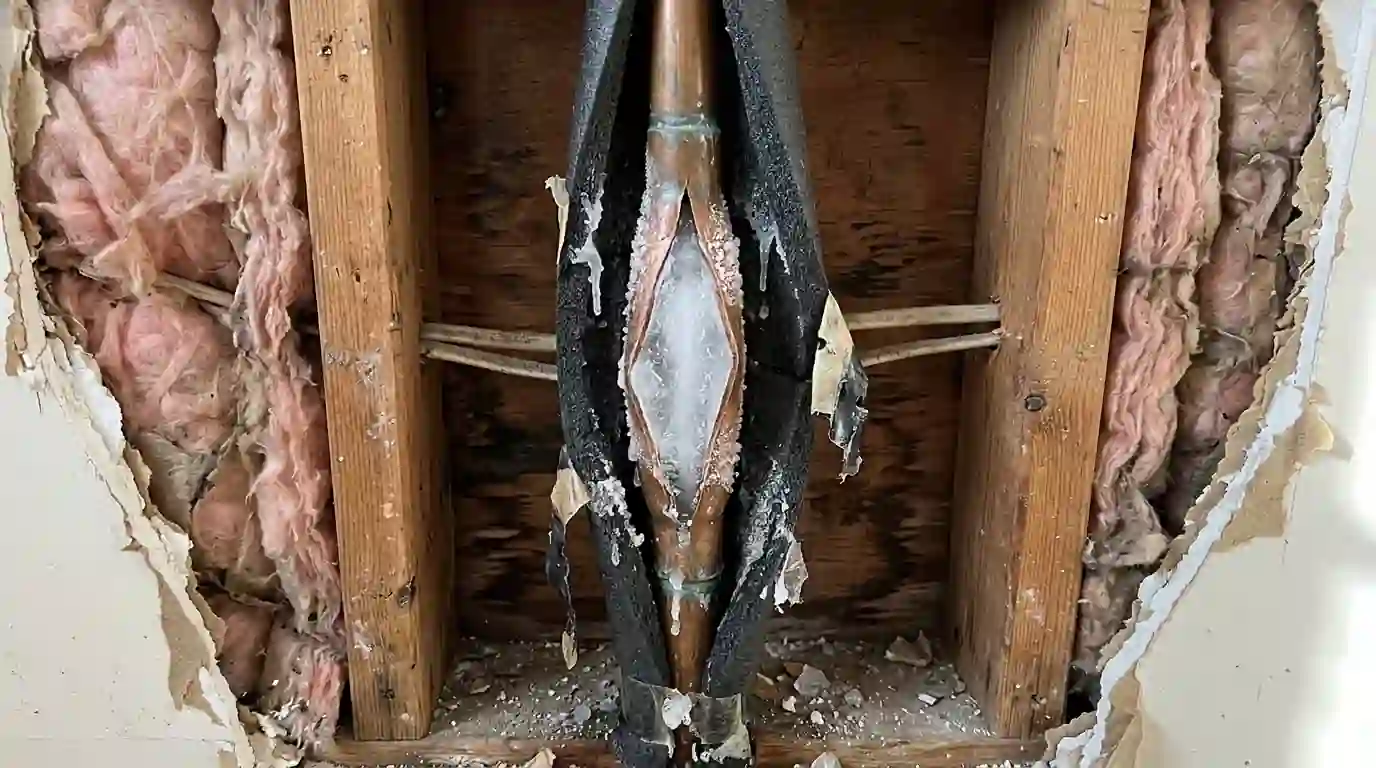
A frozen line splits while it is frozen and leaks when it thaws, which is why the water often appears a day after the cold snap. The damage clusters in exterior walls, unheated corners, garages and crawl spaces. We extract, open the wall where the readings are highest and set drying equipment into the cavity. Published guides put extraction and drying at about $4 to $12 per square foot.
Supply line and valve failures
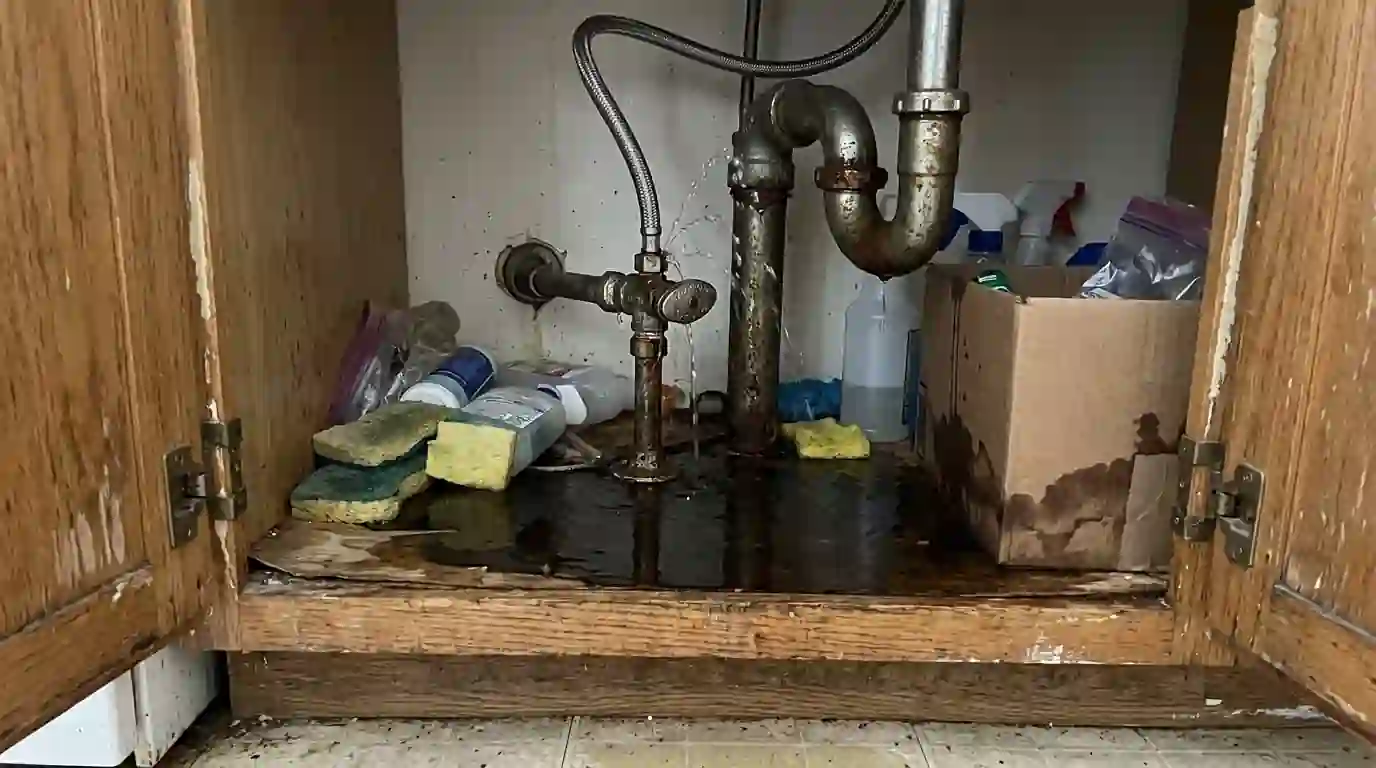
Braided hoses under sinks and toilets, shutoff valves and compression fittings fail without warning, often while nobody is home. Because the line never stops pushing water, these jobs run wide rather than deep: the water spreads across the floor and under cabinets. We pull toe kicks, check under the cabinet base and dry the subfloor. If it reached another unit, our page on ceiling leaks from above covers that side.
Pipe leaks inside walls
Pinhole leaks and weeping joints can run for weeks before anyone notices. By then the drywall or plaster has softened, the insulation is soaked and there may be growth on the back of the wall. We use leak detection and moisture mapping to find the edges of the wet area and remove only what cannot be dried. Published guides put drywall replacement at about $1.50 to $3 per square foot and plaster repair at about $6 to $19.
What happens after a pipe bursts and you call
Stop the water
If the valve is still open, we talk you through closing it or reaching the super before anything else.
Extract
Standing water comes off floors, out of carpet and from under cabinets with truck-mounted or portable extractors.
Map the wet area
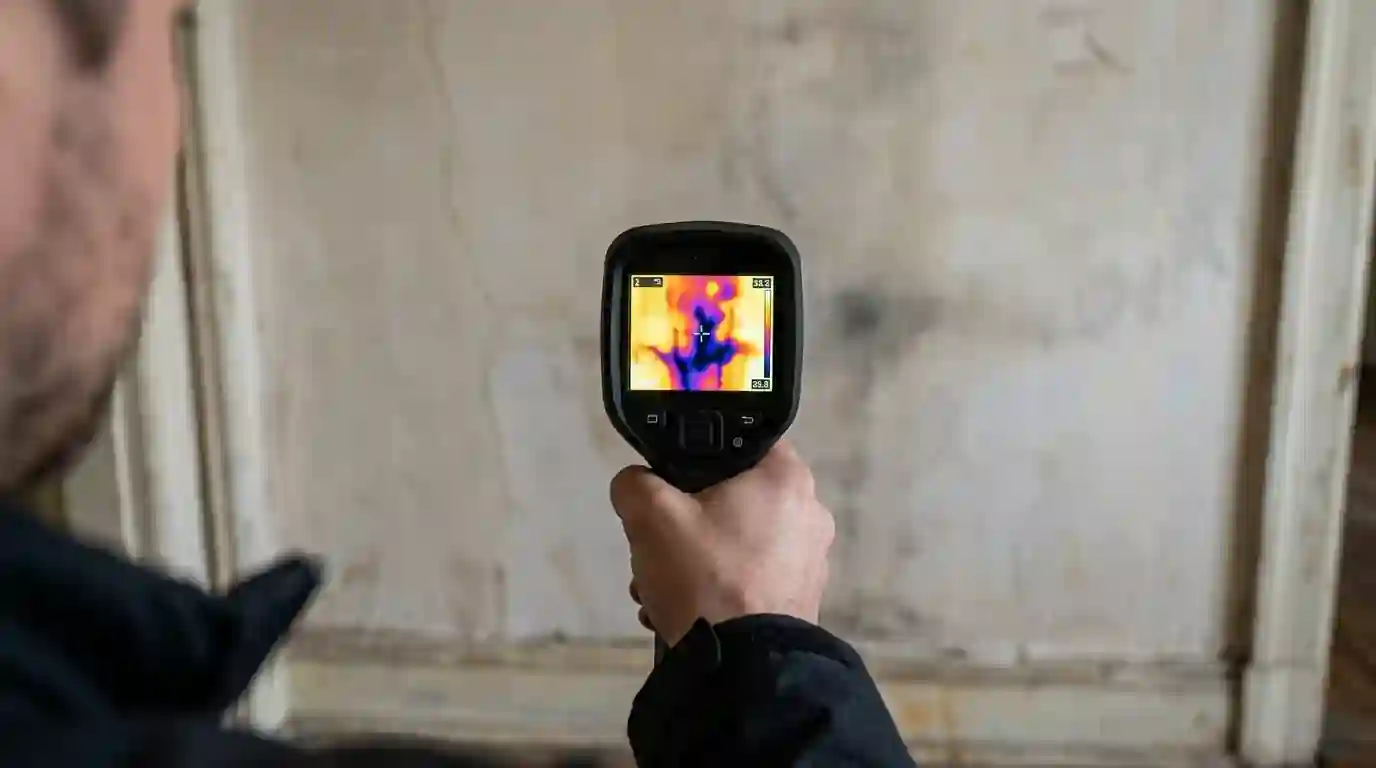
Meters and thermal imaging trace how far the water ran inside walls, under floors and into the unit below.
Open and dry
We cut only where readings say, then set dehumidifiers and air movers into the wall cavities.
Log until dry
Readings go into a daily log with photos. When every point reaches its dry reference, the wall can close.
Burst pipes in older New York buildings
More than half of the city's housing units are in buildings put up before 1947, and many are low-rise walk-ups with uninsulated masonry walls. That matters for a burst pipe in two ways. Supply lines running along a cold exterior wall are the ones that freeze and split, and the plaster and brick around them hold water far longer than drywall does. In those buildings we plan for longer drying and more readings, not a bigger tear-out.
Burst pipe cleanup: what you can do and what takes equipment
| What you can do | What we bring | |
|---|---|---|
| Stopping the water | Close the fixture valve or the main | We confirm it is off and check the other lines |
| Standing water | Towels and a wet vacuum for a small spill | Truck-mounted and portable extractors |
| Hidden moisture | Press for soft spots | Meters and thermal imaging inside the wall |
| Drying | Fans and open windows | Dehumidifiers and air movers sized to the rooms |
| Proof for insurance | Phone photos | A daily moisture log with photos and readings |
Fans alone push damp air around the room. Without dehumidification the moisture stays in the building.
What burst pipe cleanup costs in New York
How far the water traveled matters far more than the break itself.
| Job | Typical range | Source |
|---|---|---|
| Extraction and drying, per square foot | $4 to $12 | HomeGuide |
| Drywall replacement after water, per square foot | $1.50 to $3 | HomeAdvisor |
| Plaster repair, per square foot | $6 to $19 | HomeAdvisor |
| Typical total for a water damage job | $2,000 to $6,000 | HomeGuide |
These are planning ranges from published national cost guides, not a quote and not our price. We give you a written scope after we have measured the damage.
How long it ran
A line that ran overnight soaks far more material than one caught in minutes.
Clean or not
Supply water starts clean; left sitting, it degrades and more has to come out.
Plaster or drywall
Prewar plaster and lath cost more to open and restore than drywall.
Floors below
Water that reached the unit below adds a second set of rooms to dry and document.
Cabinets and built-ins
Kitchen and bath cabinets may need to come off the wall to dry behind them.
Access
Walk-ups, elevator bookings and building work hours affect time on site.
Rebuild scope
Tile, paint matching and trim after drying add to the total.
Burst pipe questions from New York callers
Short answers. Call if yours isn't here.
Close the valve nearest the break first. If you can't find it or it won't turn, close the main in a house, or ask the super to shut the riser in an apartment building.
Often, if it was clean water and it was caught early. Drywall that has swollen, crumbled or started to grow mold comes out; sound drywall can dry in place.
Sudden bursts are commonly covered, while slow leaks over time often are not. We document the source, readings and drying so your adjuster has what they need; the decision is theirs.
We handle the water damage: extraction, drying and rebuilding. The pipe repair is plumbing work and should be finished before the wall we opened is closed.
Keep heat on in rooms with plumbing on outside walls, open sink cabinets on cold nights and insulate lines in unheated spaces. Let a faucet drip in a hard freeze.
Tell the super and your neighbor right away. We can document and dry both units and keep separate records so each insurer sees its own rooms.
Other water damage work
Ceiling Leak Water Damage
Ceilings, walls and floors soaked by a leak from the unit or roof above.
Structural Drying
Dehumidifiers, air movers and daily readings until the structure is dry.
Leak Detection
Thermal imaging and moisture mapping to find where the water actually went.
Emergency Water Removal
Truck-mounted and portable extraction for standing water on any floor.
Drywall and Plaster Repair
Prewar plaster, lath, moldings and drywall rebuilt after water damage.
Pipe burst and the water is still spreading?
Close the nearest valve, then call. We answer day and night and walk you through the first few minutes on the phone.
Updated September 2026