Guide: water damage
Water damage in your apartment: what to do in the first hour
The first hour decides how much has to come out. Here is the order that protects your apartment, your neighbor's ceiling and your claim.
By Wallace Blackwell, Restoration Guides Editor
Quick answer
In the first hour after water damage in a New York, NY apartment, stop the source, cut power to wet areas, photograph everything and move belongings out of the water. Wet materials can start feeding mold within 24 to 48 hours, so call for extraction and drying as soon as the water is stopped.
Stop the water first
Everything else waits until the water stops. If it's coming from a fixture in your apartment, close the valve that feeds it: under the sink, behind the toilet, behind the washer or on the line to the dishwasher. Turn clockwise, firmly but without forcing an old valve until it snaps.
If you can't find a valve, or it won't close, call the super. In apartment buildings the water to a line of apartments is controlled by a riser valve in the basement or a shaft, and only the building staff should close it. In a house, the main is usually where the water line enters, in the basement or a front closet.
If the water is coming from above, you can't stop it yourself. Call the super or managing agent right away and knock on the door upstairs. Our guide on leaks from the apartment above covers what happens next.
Make the room safe
Water and electricity are the first risk. If water is near outlets, a power strip or a ceiling light, turn off that circuit at the panel, but only if you can reach the panel without standing in water. If you can't, stay out of the room.
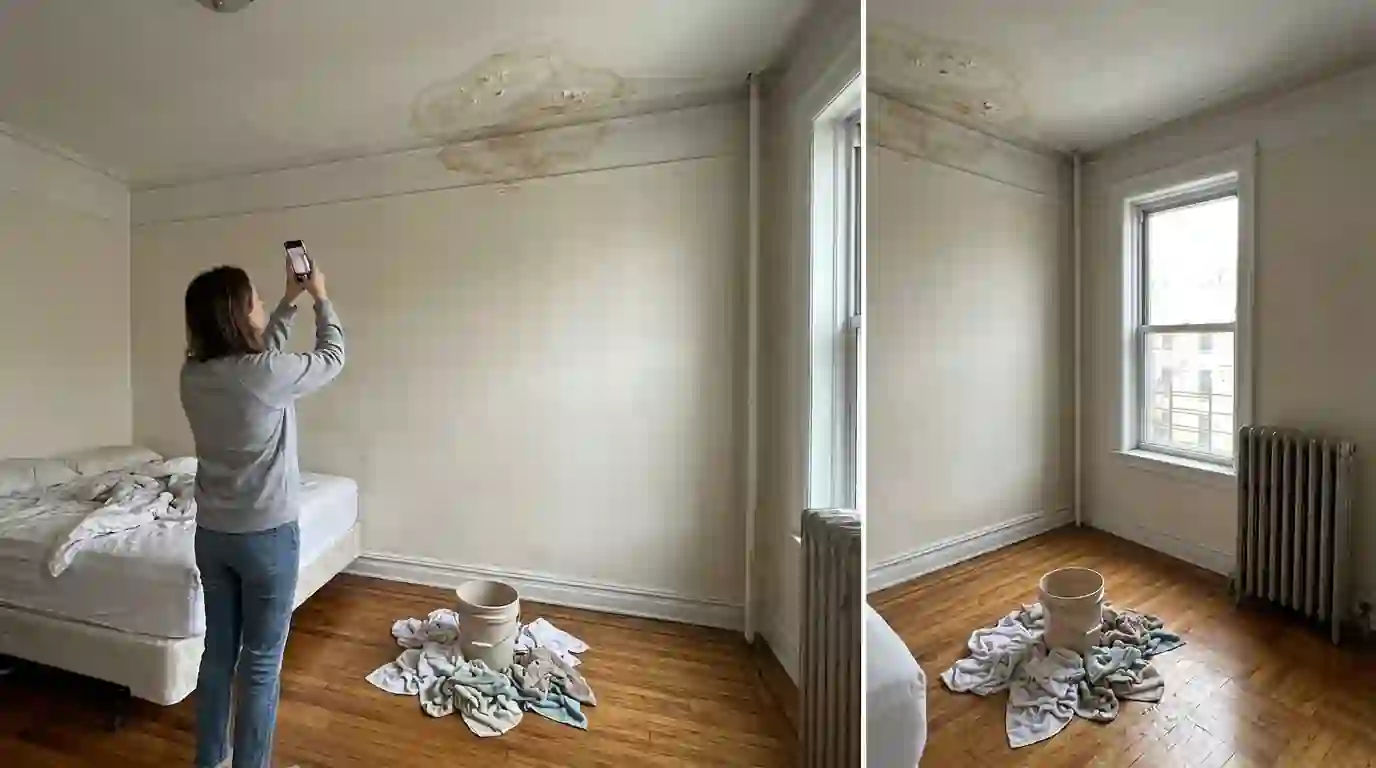
A ceiling that sags or bulges is holding water and can come down, plaster and all. Keep people and pets out from under it, and move what you can out of the way from the side. Wet floors are slippery, and wet hardwood can be a trip hazard as boards lift.
Don't use a household vacuum on standing water, and don't turn on a ceiling fan under a wet ceiling.
Document before you move anything
Take photos and a short video of the source, the water on the floor, the stain on the ceiling and anything damaged, before you start cleaning up. Include a wide shot of each room and close-ups. Your phone's timestamp matters later.
Write down when you noticed the water, what you saw and who you called. Keep damaged items rather than throwing them out; your insurer may want to see them. If the water came from another unit, note which one and when you told the building.
Protect what you can
Lift rugs, papers, books, electronics and anything with sentimental value off wet floors. Put aluminum foil or plastic lids under furniture legs so stain and swelling don't spread from the wet floor into the wood. Open closet doors and drawers in wet rooms so they don't trap moisture.
If it's dry outside, open windows to move air. Don't try to dry walls with a hair dryer or space heater, and don't start pulling up flooring. Pulling wet carpet or boards before they've been read often ruins what could have been dried in place.
Who to call, and in what order
Call the super or managing agent if the source is in the building's pipes or another unit. Call a restoration company for extraction and drying; the sooner water is out, the more can be saved. Then call your insurer to open a claim, and tell your neighbor below if water may have reached them.
When you call us, we'll ask where the water is, how long it's been there and whether it's stopped. That tells us what to bring. The extraction and drying usually start on the same visit.
What not to do in the first day
Don't wait to see if it dries on its own. Walls and floors can feel dry and still hold water inside, and that's where mold starts. Don't paint over a stain, close up an opened wall or put flooring back until readings say the materials are dry.
And don't throw out damaged belongings before they've been photographed and listed. Once they're in the dumpster, they're very hard to claim.
First-hour questions
Short answers for the moment it happens.
Only the circuits near the water, and only if you can reach the panel without standing in water. If you can't, stay out of the room.
Yes. You're expected to prevent further damage. Photograph everything first and keep damaged items.
Usually, for a clean water leak in one room. Sewage, heavy water across the apartment or a sagging ceiling are reasons to stay elsewhere.
As soon as the water stops. Mold can start within 24 to 48 hours.
Not yet. Leave it until it's been read; it can often be dried in place if the water was clean.
That depends on the cause, the building's rules and the policies involved. Report it in writing and document everything.
Treat it as contaminated. Keep people and pets away and call; it needs protective gear and removal of porous materials.
Water on the floor right now?
Stop the source if you can and call. We answer 24/7.