Guide: costs
What water damage restoration costs in New York, NY
Published ranges, and what moves a city job up or down. No quote in a guide can price your job, but these numbers show where the money goes.
By Wallace Blackwell, Restoration Guides Editor
Quick answer
Water damage restoration costs about $3,865 on average nationally, with most jobs between $450 and $16,000, according to published cost guides. In New York, NY, prewar plaster, walk-up access and building rules can push a job higher within that range. The biggest single factor is how long materials stayed wet.
Published price ranges
These are national planning ranges from published cost guides, not our prices and not a quote. They're useful for seeing which parts of a job cost the most.
| Job | Published range | Source |
|---|---|---|
| Water damage restoration, national average | national average about $3,865; most jobs $450 to $16,000 | Angi data as published by SERVPRO, 2026 |
| Water damage restoration, typical total | $2,000 to $6,000 | HomeGuide |
| Mitigation by water class, per sq ft | about $3.50 clean, $5.25 gray, $7.50 black water | Angi data as published by SERVPRO, 2026 |
| Extraction and drying, per sq ft | $4 to $12 | HomeGuide |
| Drywall replacement, per sq ft | $1.50 to $3 | HomeAdvisor |
| Plaster repair, per sq ft | $6 to $19 | HomeAdvisor |
| Hardwood repair after gray water, per sq ft | $10 to $15 | HomeAdvisor |
| Full bathroom cleanup and repair, 120 sq ft | as much as $3,000 | HomeAdvisor |
The per-square-foot numbers matter most in practice, because the size of the wet area drives everything else.
What pushes a New York job up
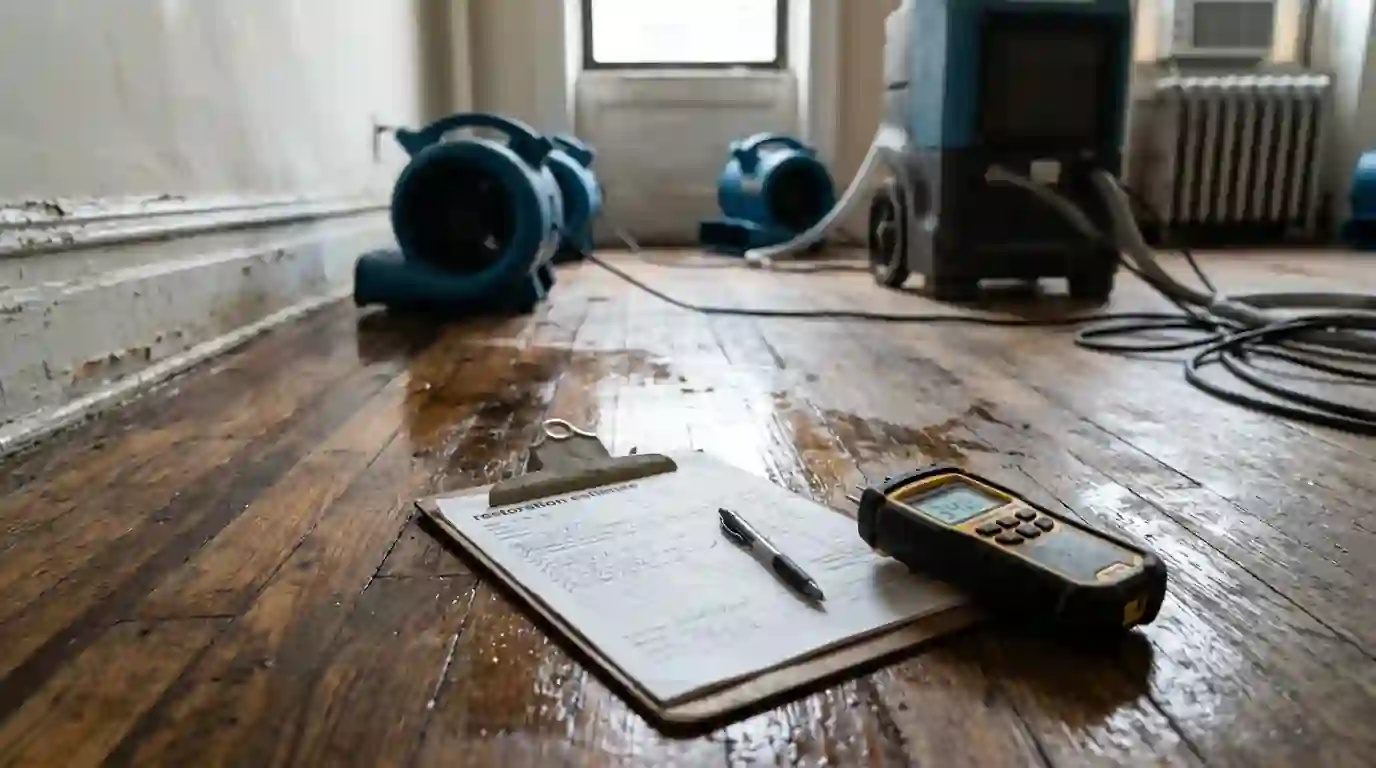
Plaster on lath costs several times more to repair than drywall, and a lot of the city's apartments still have it. Walk-ups mean equipment carried up stairs; high-rises mean elevator bookings and work hours set by the building. Contaminated water, from a toilet or a sewer, adds removal and cleaning to every square foot.
Time is the biggest factor. A leak caught in an hour is mostly extraction and drying. The same leak found three days later means removed drywall, lifted floors and possibly mold.
Mitigation first, rebuild later
Most jobs have two phases. Mitigation is the emergency work: extraction, removing what can't be saved, drying and monitoring. Rebuild is putting back drywall, plaster, floors, cabinets and paint. They're often priced separately, and the rebuild can't be priced properly until the mitigation shows what had to come out.
That's why an early number is a range, and a firm number comes after the drying. Our page on water damage restoration explains the sequence.
How insurance fits in
If the damage is covered, your insurer pays for the work minus your deductible. The adjuster works from the documentation: photos, moisture readings, what was removed and why. A daily drying log is the single most useful thing you can hand them.
Flood from outside is usually a separate policy from water damage inside. Our guide on flood versus water damage insurance explains the difference.
How to keep the cost down
Stop the water fast, get extraction started the same day and don't tear things out yourself before they've been read. Drywall and floors that could have been dried in place become replacement jobs when they're pulled out wet.
Keep damaged items until they're documented, and ask for readings, not guesses, before anything is removed.
Where the published numbers come from
The ranges above come from national cost guides that survey contractors and homeowners across the country. City jobs often land higher within a range because of access, labor and older materials, and a small job can cost more per foot than a large one because setup and the first days of equipment cost the same either way.
Treat them as a planning tool for a conversation with your insurer and your contractor, not as a price anyone owes you.
Why the first day decides the bill
Most of the difference between a small job and a large one is decided in the first 24 hours. Water caught and extracted the same day usually means drying in place. The same leak found two days later often means removed drywall, lifted flooring and sometimes mold, which is where the published ranges climb fastest.
Reading a restoration estimate
Expect line items for extraction, removal of specific materials by square foot, antimicrobial treatment, drying equipment by the day, daily monitoring, and debris disposal. Rebuild estimates list materials and labor by room.
Question anything that isn't tied to a measurement. Equipment days should match the drying log; removal should match the readings and photos.
Cost questions
What people ask about price.
We can explain what drives the price and share published ranges. A written scope follows once we've measured.
They cover everything from a wet closet to a flooded house. Area and time wet make the difference.
Yes. Published guides put plaster repair at about $6 to $19 per square foot against about $1.50 to $3 for drywall.
Sometimes. It depends on your insurer and what you agree; ask your adjuster.
The part of a covered loss you pay before insurance pays the rest.
A little. It runs day and night for several days; ask your insurer whether they reimburse it.
Not if it skips readings or leaves wet material in place. That's how mold and repeat repairs happen.
Want to know what your job will involve?
Call and describe it. We'll explain the likely scope and cost drivers.